Showing posts with label gingivitis. Show all posts

Tuesday, December 1, 2015

Think Before You Eat and Drink

It’s the silly season again and that means lots of parties and lots of food, and even if you are watching your weight, there are some foods that you should avoid or keep to a minimum to keep your teeth and gums healthy.

When you eat foods and drinks that contain sugar, the bacteria that naturally occur in your mouth will feed on sugar creating acids. Those acids will wear down the enamel making it weaker. The weaker your tooth’s enamel, the more susceptible you will be to tooth decay and gum disease.

The holidays are known for lots of goodies including sweet treats, cakes, candies and deliciously sweet dried fruit, however, those dates and dried cherries in the fruitcake could cause problems for your teeth. Dried fruit may be good for your figure, but can also stick to your teeth. If you must enjoy a dried apricot, fig, or date, rinse your mouth with water afterwards.

If you snack on sweets all day or over an extended period, such as a holiday party or holiday event, it can be especially harmful, as damaging acids will form in your mouth every time you consume a snack that is loaded with sugar. Even healthy servings of cranberry sauce can cause those acids to start forming. If that isn’t bad enough the sugary treat will continue affecting your teeth for 20 minutes or more after you have finished.

Snacking on sugary drinks and sweets all day long will increase your risk of gum disease and decay. If you brush and floss after indulging, you will see a reduction in bacteria.

When it comes to keeping cavities at bay, your dentist recommends that you balance out your sugary drinks and sweets with other types of foods. Eating sweets with foods that are rich in carbohydrates will help ease the impact that sugar will have on your teeth.

If you must indulge, choose wisely and consume sweets that dissolve quickly as this will limit the contact with the enamel on your teeth. Instead of caramels and gummy Santa’s, opt for plain dark chocolate, which is said to be good for your teeth.

Make sure that you are prepared and carry floss and a toothbrush with you. If you are eating sweets, it is important to brush if you can. However make sure that you wait about a half an hour if you are consuming foods that are acidic, such as wine or citrus fruits, as brushing can soften the enamel if you do not wait.


This holiday season think before you eat and drink, and remember to schedule an appointment with your dentist for the New Year. 

Saturday, August 1, 2015

Root Planing and Scaling for Gum Disease

Root Planing and Scaling is a treatment that is used by dentists to prevent the spread of gum disease, and if you are experiencing bleeding gums, you may want to schedule an appointment with your dentist who can determine if your periodontal disease can be treated with Root Planing and Scaling.

Oral B explains that Root Planing and Scaling is one of the most effective treatments to halt the progression of periodontal disease stopping it in its tracks before it becomes more severe. Root Planing and Scaling cleans between your teeth and gums down to the roots of your teeth to get rid of plaque and tartar accumulation.

When you schedule an appointment with your dentist, x-rays will be taken to determine if you are suffering from gingivitis or the more serious periodontitis. During your periodontal examination and probing, your dentist will be able to determine how healthy your teeth and gums are. This will help your dentist diagnose gingivitis or periodontal disease while also revealing exposed roots, receding gums, tooth grinding or any other problems that you may be having.

During the examination and probing, your dentist will measure the spaces between your teeth and your gums. If there are concerns regarding the health of your gums, your dentist may refer you to a specialist, or periodontist.

If your dentist decides to perform a Root Planing and Scaling, a local anesthetic may be used to numb the roots of your teeth and your gums. Once you are numb, your dentist may use a standard scraping tool or an ultrasonic tool during the Root Planing and Scaling. Antibiotic fibers may also be placed in the pockets to help speed up the healing process while helping to prevent infection. The fibers will remain for about a week before being removed by your dentist during your next appointment.

Root Planing and Scaling causes very little discomfort, although you may be a bit sore after the treatment.

Gum disease can be serious if left to its own devices causing all kinds of problems including tooth loss. If left untreated your gingivitis can progress to the more serious periodontal disease.

If you are experiencing bleeding, red or swollen gums, schedule an appointment with your dentist who can determine if you need a Root Planing and Scaling treatment.

Monday, June 15, 2015

Can Gum Disease affect Cognitive Function?

Bleeding gums are a sign of gum disease. Gingivitis, and the more severe periodontal disease should be taken care of immediately, otherwise you may eventually lose your teeth. However, what is even more shocking is that gum disease and tooth loss could also cause a decline in thinking skills, especially among people over the age of 50.  

Researchers are investigating whether people who have poor dental health also suffer from poor cognitive functions, which technically mean people who have gum disease also have problems with managing numbers, words, and memory.

Recent research indicates that that every person, whether male or female, who had a tooth removed or had lost a tooth, saw a loss in cognitive function. In fact, people who had lost all of their teeth had quite poor cognition compared with those who had more. The study also found poor cognitive behaviors in people who suffered from severe gum disease, or periodontitis.

Conducted in 1996 and lasting until 1998, the study consisted of data that was gathered from people who took part in memory and thinking skills tests. The 6,000 participants were both men and women between the ages of 45 and 64. Thirteen percent of those who took part in the study had lost their natural teeth with about a fifth of the participants having less than 20 teeth remaining. About 12 percent of the participants had deep gum pockets and serious bleeding gum issues.

What the researchers discovered was that the scores on thinking and memory tests, including number skills, word fluency and word recall, was lower in people who didn’t have teeth. People who had better oral health and more teeth had better test scores than those with severe gum disease as well.

Some researchers believe that poor dental health may reflect poor eating habits. People with tooth and gum problems may not be able to eat certain, “Brain foods,” which could contribute to poor cognitive functions. Researchers agree that it could be a contributing factor, but so could inflammation from gum disease. Inflammation, regardless of where it is located in the system can affect cognition.

So what’s the bottom line? Good oral health habits just may help you think better and remember where you put your keys.


If you would like more information regarding oral hygiene, schedule an appointment with your dentist today. 

Friday, August 15, 2014

Your Bad Oral Hygiene Could Be Making You Sick

Most people have no idea that plaque and tartar buildup could make you sick. In fact, if you suffer from gingivitis or periodontal disease your dentist will tell you that you could be setting yourself up for all kinds of problems including heart disease.

According to Web MD, that bacteria, known as plaque, will build up on your teeth unless you brush twice and floss once a day. If left to its own devices, plaque will cause your gums to bleed and be inflamed.

Recent research has indicated that periodontal disease can cause problems for the rest of your body as well. Some of the health problems include dementia, heart attacks, and even diabetes. Although scientists have been unable to establish why this happens, they have identified links between health problems and poor oral health.  

Plaque constantly forms on your teeth when you eat or drink beverages and foods that contain starches and sugars. Once the bacteria have released damaging acids, it will attack the enamel on your teeth. Plaque acts like a glue of sorts keeping the acids in constant contact with the enamel on your teeth. Over time, the breakdown of your enamel will lead to tooth decay.

If your gums are tender, swollen and bleed after you brush or floss you could have gum disease, which begins as gingivitis, leading to periodontal disease. Once the gum tissue begins to pull away from your teeth, the bacteria will start to attack the bone that supports your teeth leading to tooth loss.

Some of the diseases that scientists have linked with periodontal disease include;
  • Dementia
  • Rheumatoid Arthritis
  • Heart Disease
  • Premature Birth
  • Diabetes 

Although experts have been unable to pinpoint the exact links, many dentists and doctors believe that it is the oral bacteria that escape into your bloodstream causing problems for your major organs.

In a paper written in 2009 by the American Academy of Periodontology and the American Journal of Cardiology, recommendations were made to encourage heart doctors to ask their patients if they have had, or still battle with periodontal disease. 

If you suspect that you may be suffering from gum disease, schedule an appointment with your dentist who will be able to get rid of your gingivitis or periodontal disease. 

Friday, August 23, 2013

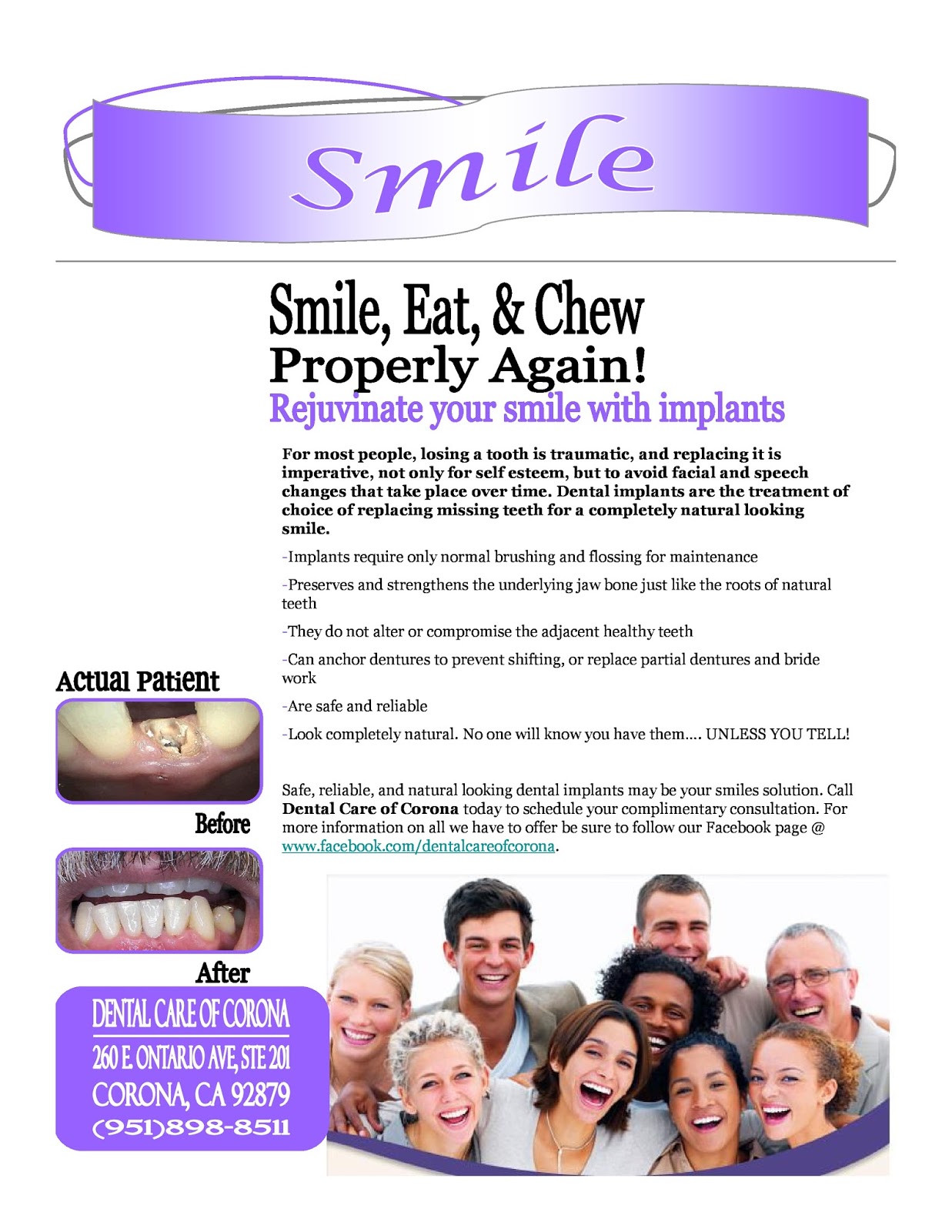
Dental Care of Corona Newsletter

Here's our latest newsletter for Dental Care of Corona.  Thanks for reading and please contact our Corona Dental office with any questions you may have.